The Vault Regulars

Tuesday, April 30, 2024

Glasgow Day1, Part 2.

 Part 2.

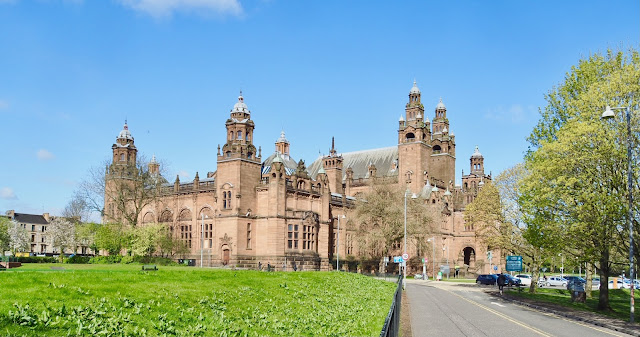
We left Kelvingrove after a delightful few hours. We could have stayed longer. On exiting the building we found out that there are two more galleries with five minutes walk away. We will do them next time.

Finding the footpath adjacent to the River Kelvin we handrail it down to the confluence with the River Clyde. It was a very warm afternoon and many people were out jogging or dog walking.

The confluence of the rivers is where the Tall Ships are located alongside the Riverside Museum. This is a complex which was completed in 2011 and took four years to build. It covers Transport and Technology.

Photograph was imported from the website as when we were there it was fenced off for works.

The Glen Lee.
From this point a footpath/cycle way follows the Clyde all the way back into town and beyond. It's a promenade and Glasgow have done a fantastic job of changing what was a huge industrial area into what is now a delight to walk with many points of interest.

One of the nice things in Glasgow is the amount of murals painted on buildings. They are superb. I will just post a couple here but there are so many that you can walk around the city locating them and photographing them. We managed to photograph 20 but there are many more.


Looking back down stream to the Transport Museum.
We came across this building and it turned out to be a distillery. 
Something else to add to the list for next time.
The Clydeside Distillery was opened in 2017 after a £10.50 million refurb of what was an old pump house. The pump house originally managed the flow of water into the Queens Dock.

The Waverley. 
I'm sure some folk will have memories of travelling on her as she was very popular around the Lake District coast and the Isle of Man etc.
Promenading.

Glasgow Science Centre across Millennium Bridge.

There are many hotels in Glasgow like this one. I believe there are 43,000 tourist beds so there is enough completion to haggle the prices.
The Armadillo or SEC Auditoriam, and the Ovo Hydro for indoor events.

One of the remaining huge industrial cranes.

Front entrance of the Armadillo.

More promenading back to our hotel. 
What a wonderful day.


Sunday, April 28, 2024

Glasgow. Day1. Part 1.

 23rd April 2024.

I have only every driven through Glasgow, twice I think and never stayed overnight. This trip was a little strange to say the least as it was only a partial plan. 

The plan was to do with Sheila. She wanted to do the West Highland Way, something I have never considered due to the amount of people who walk it. However, because I was in recovery from Prostate Cancer therapy which I have only just finished at Christie Oldham, I wasn't going to argue over "an easy" backpacking trip.

The plan was scuppered in the end because I just wasn't mentally or physically ready for such a trip, even an easy one and therefore decided that we would go to Glasgow as planned but spend three nights there as a mini break. I didn't want to drive and so went by train which turned out to be a very enjoyable and stress free.

We arrived at Central Station which was very busy and I pictured what it would look like in a few weeks time when it would be packed with TGO Challengers. Leaving through the Union Street door on a warm afternoon we soon found the Premier Inn where we had booked our stay. 

After a good nights sleep we headed out into town and our route was to walk to Kelvingrove Park and Museum. It started on St Vincent Street which was busy with people heading to work, heads down, earphones in, eating breakfast on the hop etc etc.....

Then along Argyle Street until with reach Kelvingrove Street which led straight into the parkland. We had slight problems finding our way at one point, just where we cross the very busy M8 motorway. There are lots of routes and walkways and it was quite confusing to first timers like us. So we sat down and looked at the OS mapping and Apple maps to make sure we were taking the right route. We soon found a signpost on a cycle route which confirmed the way.

Kelvingrove park is delightful and wasn't too busy at this time of the morning. It was another lovely blue sky day with temperatures at 14 degrees C. Summer had arrived.

We spent a fair bit of time walking the pathways and taking the views high up at gorgeous housing complex called "Park Circus". What splendid buildings and architecture. We must of said "Wow" a hundred times. Photographs don't do the area justice. What a place to live.

THE STEWART MEMORIAL FOUNTAIN
Shame it wasn't working. It has been switched off due to constant vandalism after it was restored in 1988. The fountain is in the French Gothic style. Its designer beat off 75 other suggested designs. The architect, 27yr old James Sellers won the international competition. It was built in 1871-72 of Granite and Sandstone and commemorates Lord Provost Robert Stewart.

A SMALL PART OF WHAT IS, PARK CIRCUS

View across the park to our next destination. Kelvingrove Museum.

The museum is on the west side of the park. We followed the paths down to the bridge over the River Kelvin, past an outside auditorium then across another bridge leading to the Museum Carprark. If anyone is thinking of doing the West Highland Way and isn't pushed for time then an alternative "add on" could be the River Kelvin Walkway which starts at the confluence with the River Clyde and ends in Milgarvie. It would only add a few hours onto the route and it is 10km long. 

THE RIVER KELVIN


THE FRONT AND REAR ENTRANCES TO THE ART GALLERY AND MUSEUM

Once inside the building the eyes just don't know where to stop and look, its staggeringly beautiful. You can do a guided tour or just wander around the place at your leisure which is what we did after having a coffee. The coffee was far from great but it was hot and wet.
You pay nothing on entry but you can give a donation if you wish. A ground floor plan of all the building is available for free.

The Foyer or Main Reception Hall with the concert organ high up. Recitals are played on certain days during the week. The sound must be amazing.

Looking away from the organ area towards the front main entrance.

The museum and art gallery is huge and we spent hours here. I took dozens of photographs as there was no restrictions on doing so. Below I will post just a few of them. Hopefully you will be tempted to go yourselves one day.

Egyptology section


The Spitfire, a survivor of WW2. The info on the plane was provided by a friend in the know and not by the museum.

Serial #: LA198
Construction #:
  SMAF.4338
Civil Registration:
  None
 Model:
  Spitfire F.21
Name: None
Status: Displayed
Last info: 2013

History:
Air Training Corps, Perdiswell, Worcester, February 19, 1954-1967.
RAF Henlow, 1967-1968.
- Used in movie Battle of Britain for static scenes.
RAF Locking, September 1969-1986.
- Displayed on plinth as LA198/JX-C.
RAF Lechars, March 15, 1986-1989.
- Gate guard as LA198/RAI-G.
RAF St. Athans, April 5, 1989-1995.
- Stored pending disposal.
RAF Museum Store, RAF Cardington, 1995-1998.
- Stored.
City Of Glascow, Scotland, November 1996-2004.
- Arrived dismantled, East Fortune, March 4, 1998.
-- Marked as LA198/RAI-G.
- Under restoration, East Fortune, 1998-2002.
Museum of Transport, Glasgow, September 17, 2003-2006.
Kelvingrove Art Gallery & Museum, Glasgowm July 2006-2013.
- Hanging in main hall.


After a long chat with one of the museum guides, who gave us lots of info on Glasgow and what to see and do, where to stay and where to travel to from Glasgow we decided we had better get going as we still had a bit of a walk back to the hotel. 

It turned out to be another delight so I will do a Day1 part 2.


Saturday, March 2, 2024

The Gateway to the Southern Pennines.

Wednesday 28th February 2024 

Or so the area board says. 

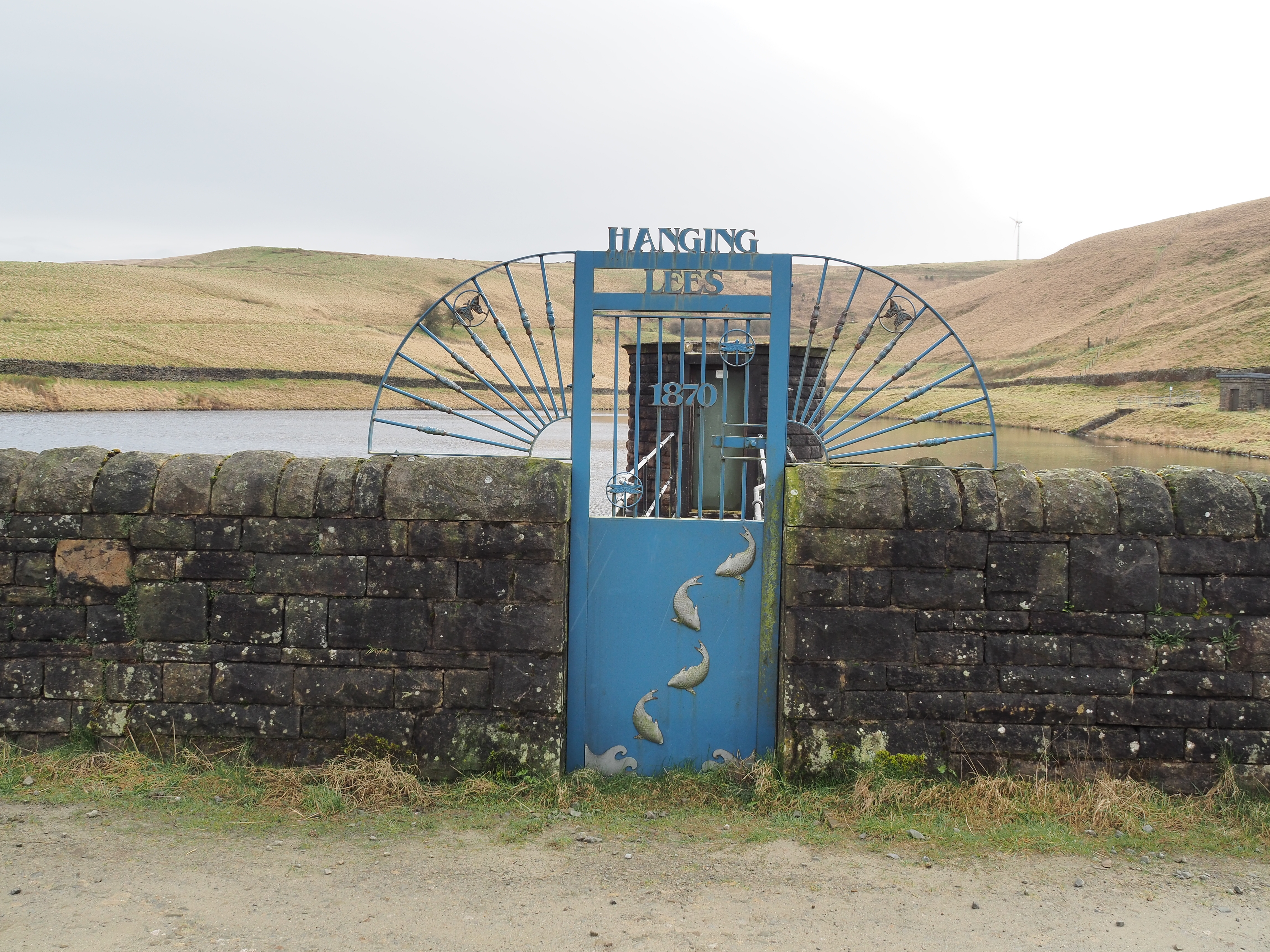
I for one had never considered it to be the gateway but there are certainly lots of nice gates on the walk around the reservoirs and beyond.


It was good to find the car park adjacent to Ogden Reservoir was free and the toilets open from 8am to 8pm also free. Well done Oldham Council. 

We set off east along a narrow road passed the old Spring Mill. The mill looked shut but maybe repurposed as a storage facility. I don't think the mill is too old as it isn't on the 1840-1880 OS map and neither is the Ogden Reservoir.

Spring Mill.

A little further along we came across a spring which had been nicely built around. Did it have any relevance to the name? I have since found out that this "spring" is actually part of a culverting system.


Notice the stone footpath arrows above the spring. There are many of these fantastic signs along the route. Never need replacing. Another good move from Oldham Council.
We chatted to three local dog walkers who were impressed with Sheila looking at a map. Very professional they said, blind as a bat, I said. We had a good laugh about navigating with the sun and the stars and then we bade farewell.


Signage on the trees gave me a bit of an impression I wasn't welcome to advance.
Our only view of Ogden Reservoir was through the woodland. We would have to wait until we got round the other side before getting a full view.

Our first view of Kitcliffe Reservoir.

There are six reservoirs in this area which were built during the late 19th centuries taking advantage of the vast amount of rainfall and sodden moorland. Built to supply power to the mills, six I believe were in this vicinity and also to supply water to Oldham and Manchester. They were built following the Oldham Corporation Gas and water act of 1855. Strangely, the lowest reservoir and nearest to the mills was built last.
  • Norman Hill Reservoir
  • Hanging Lees Reservoir
  • Piethorne Reservoir
  • Kitcliffe Reservoir.  
The above were built between 1858 and 1866. 
  • Ogden Reservoir
Was built 1872-1878
  • Rooden Reservoir (which we didn't walk past today)
Was built 1894-1901.

A footpath follows Ogden Reservoir boundary wall down to Kitcliffe farm which prior to the reservoirs being built was a Fulling Mill with its own water supply. It may be interesting going down to see if anything remains of the old mill but today it wasn't in the plan.

Carrying on eastwards the large expanse of Piethorne was next. There was a resident fly fisherman which we watched for a few minutes. He didn't seem to have caught anything. Fly fishing has always fascinated me but I've never had a go at it.

You will notice on the left gate post the OS bench mark. This was the first we had spotted but the OS listing shows a couple that we had missed.
Ornate sluice system.

it was quite a pleasant day. Where was the forecast rain? I wanted it to rain to test out a new walking jacket that I had purchased from Decathlon. The clouds in front of us looked ominous but over the next 10-15 minutes we only had a very light shower. 
We got to Hanging Lees reservoir and spotted another bench mark and more ornate gates. Also, but quite a distance away was a pair of Tufted Ducks. 


Tufted Ducks.


Our path crossed between Piethorne and Hanging Lees and led up to a junction with the Pennine Bridleway. We met three mountain bikers who were finding the gradient tough but all credit to them they did it with a bit of huffing and puffing.

We couldn't get directly up to Norman Hill Reservoir because there is no public footpath around it, so we had to make do with a photo from behind the boundary wall. Norman Hill was originally a farmstead which disappeared with the building of the reservoir. It must have been a bleak spot in winter years ago.

Norman Hill Reservoir with Holme Moss mast in the distance.


Aeration waterfall from Norman Hill to Piethorne. 
Piethorn gets its name from Magpies and Hawthorns of which many were in the area.

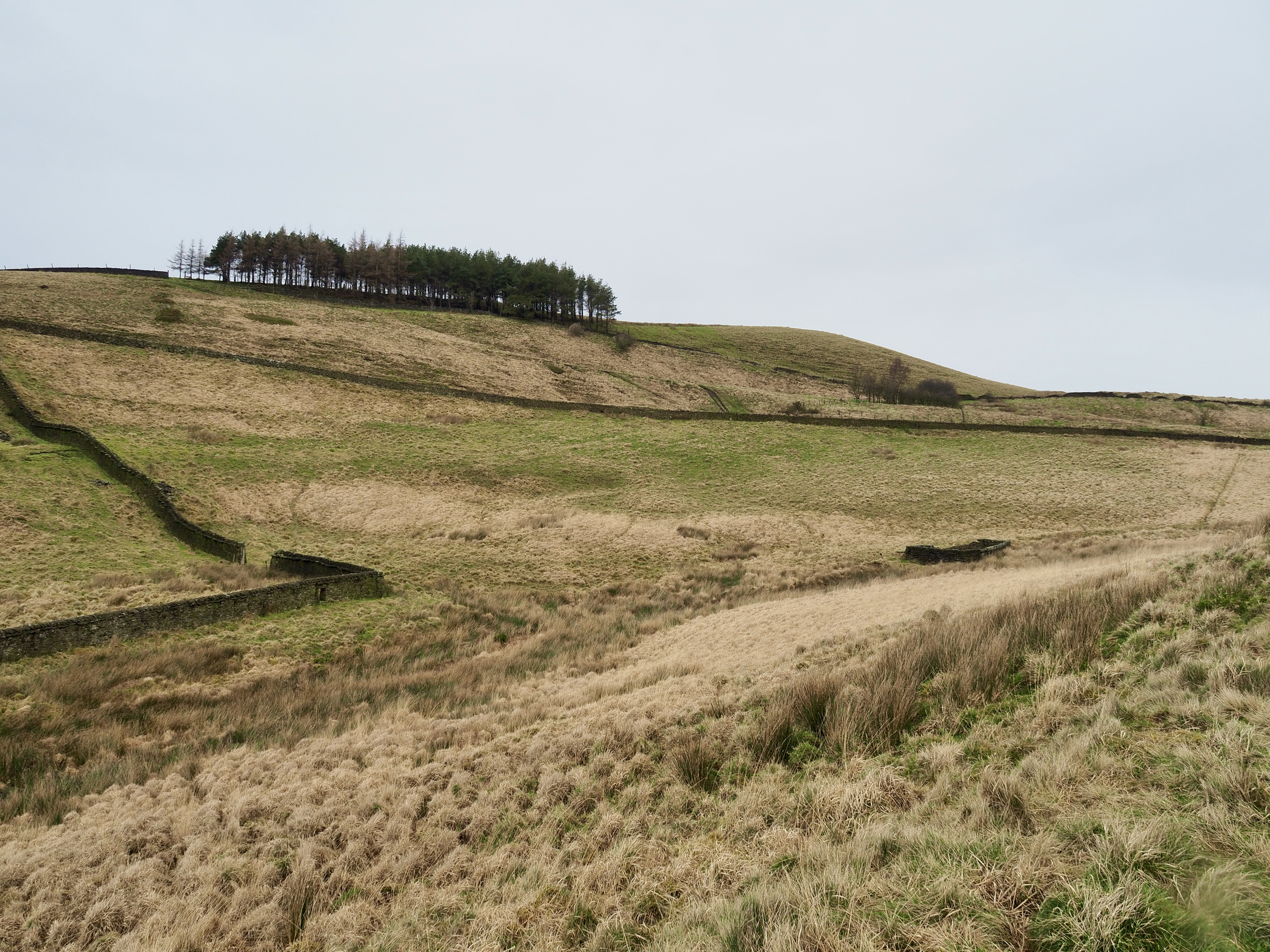
Through a gate we steadily made our way up hill passing three more ruined farmsteads, First Roughfield farm with Piethorne off to the right then a little further the farm called Close. Not much is left to see apart from some fragments of stonework if you look hard enough.

What was left at Close farm with Rooden reservoir in the background.

A kestrel searching the ground around Piethorne.

We were on a good path called Tunshall Lane which is an ancient pack horse route with high walls on both sides. Approaching Town Hill we noticed the destruction caused by off road bikes. We was going to go up there but decided it was too muddy and so stayed on the green lane.

Red lichen covering the old walls.

Sheila on Tunshall Lane.
Hillside destruction.

Another shower didn't last long but the wind as we approached the highest point of the lane was bitterly cold. We got a move on. Good views were had looking north towards Littlebourgh, with the M62 motorway bridge in the foreground and Hollingworth Lake in mid ground.


The lane headed off towards Milnrow but we headed down, back towards Ogden Reservoir. On the way we stopped to look within the remains of another farmstead called Rag Hole. This farm was a busy place in the mid 19th century where it grew crops. By the 1940's thinks were changing and the farm was  almost derelict.

Above and below, 2 shots of Rag Hole farm.


On the way down to Ogden 


The route back to the car was across the dam.

All in all this was a nice walk. Pity it didn't rain as forecast but that the fickle weather we have.

Our route. Anticlockwise from the flag marker.


I


Find it Here

About Me

My other blog. beneathwhosefeet.wordpress.com